Showing posts with label Ecuador. Show all posts

Friday, August 16, 2013

Restaurant Review: Hong Kong City in Guayaquil, Ecuador


Okay, I now have a new favorite Chinese restaurant in Guayaquil, Ecuador: Hong Kong City Restaurant. The reason can be explained in two simple words, Dim Sum. Yeah, there is Dim Sum in Ecuador.

There are a lot of chifas in Ecuador - basically oriental style foods that primarily sell different versions of chaulafan (fried rice) and tallarines (noodle) dishes. But low and behold a bunch of us were wondering down the main drag of touristy Urdesa Central, Victor Emilio Estrada, and saw a sign for Dim Sum. It was an immediate date for that evening.

Sure enough, Hong Kong City is a smallish place but a huge menu. It has the normal range of soups, rice and noodle dishes, but also has three pages of dim sum recipes.

The first real surprise, two ordered soup - one a won ton soup and the other an egg drop soup. These bad boys were huge! In fact we asked the waiter to bring some smaller bowls for me and another to sample the egg drop of my wife, Lisa. We got a nice cup each and it barely dented the massive bowl she had. And this egg drop was something else, with lots of  chicken, tofu and other ingredients along with the traditional chicken stock and eggs. Yum! It was a meal itself but more was to come.

We tried the spring rolls. They were refreshingly different since it seemed they were spiced with some sort of five-spice blend. They were good as something different, although I think I will stay with more traditional spring rolls as my typical favorite.

Of course Dim Sum was on the menu, and I loved my shrimp dumplings. We also ordered some main courses to carryout for lunches. I had curried chicken that was a tad mild, but once fired up with a bit of hot sauce it met my fire standards.

The best surprise was the bill. The total for a massive soup, an order of Dim Sum, spring rolls and two main dishes, plus two beers for me and two Coke Zeros for Lisa was $28, and we eked two more meals out of it. So three meals for two people for less than $30 is top notch in my book!

Hong Kong City Restaurant
VE Estrada 1210, Guayaquil, Guayas, 
(593) (4) 2381800

Sad but Expected - Ecuador to Drill for Oil in Amazon

I saw this coming in 2007 and now it is here: Ecuador is abandoning a program to ransom the Amazon Rain Forest and instead is going to start drilling in a United Nations designated Biodiversity Habitat. Yesterday, Thursday August 15, President Rafael Correa said he would ask the country’s congress to allow drilling in the Ishpingo-Tambococha-Tiputini oil fields located in eastern Ecuador’s Yasuni National Park.

According to a news report on Bloomberg, Correa said, “Let no one be fooled, the fundamental reason this failed is because the world is hypocritical.The world has failed us.”


Actually, I'd say Ecuador, and especially the Yasuni National Park, is the victim of Correa's policies.


In 2007 Correa announced a plan for wealthy countries to fund the non-exploitation  of the fields. The plan sought $3.6 billion over 13 years in contributions from the international community to protect the area. Contributions to a fund in return for not exploiting the fields were to be managed by the UN’s Development Program.


However, Correa bristled at any controls over the money, calling any suggestions a "attack on the country's sovereignty " an ongoing theme of the President. That, coupled with his regular policies of revoking current agreements whenever it suited his government, refusing to pay government bonds simply because he wanted to spend the money on social programs and otherwise making a name for his government being unreliable, potential donors were put off from relying on him. Then, the final point was what happens in 13 years when the payments stop coming, Ecuador would open up the national park for drilling anyway?


Donors wanted guarantees. Correa rejected guarantees as "insulting." And meanwhile, the Ecuador government is increasing spending this year 24% as it works to build a Venezuelan-style social state.


Correa needs the money. He has very limited borrowing ability because he has trashed Ecuador's credit. It was only a matter of time before he opened the fields.


Which is a shame, because Yasuni is literally a world treasure. It is sad to see the rape of its jungle lands come a large step closer.

Thursday, August 15, 2013

Ecuador’s Taste of the Inca’s – Ingapirca

To a history nut like me Ecuador = Incas + Spanish Colonialism + a lot more and so forgive me if I am a bit nuts about Ingapirca (Incapirche, Incapirke, meaning Inca Wall) which is the best preserved set of Inca ruins in Ecuador. If the ancient time of the Incans fascinates you as it does me, you will want to make room in your plans to visit Ingapirche. You can see into the past and touch history.

You can get to Ingapirche if you head east from Guayaquil towards the town of Canar. There is a road heading right to the ruins from El Tambo, which is just a little north of Canar. The scenery is jaw-dropping magnificent. Towering Andean pinks with mist shrouded valleys. Rustic farms weave their way about rocky outcroppings and tumbling streams, so you will enjoy your drive getting there. You can also get there by heading south from Quito or north from Cuenca.

Some writers have claimed the site is extensive. I wonder if they have been there. Yes, it does cover several acres, but it never was a real city by our modern standards. Essentially it was an imperial retreat coupled with an astrological observation temple. Of course, if you were Supa Inca (High King) and came to visit, that meant a couple thousand guards and retainers. However the everyday site was religious in nature, dedicated to the Sun God and Moon Goddess. Unfortunately, only the low walls and foundations are remaining for most of the area. The largest partially intact spot is the circular solar temple that once marked the movement of the sun and the solstice days. It was a central figure of Ingapirche religious life, so it's fitting that it is the main remaining part. Some of the palace buildings are still partially intact. Makes sense since these were likely some of the most elaborate buildings to begin with.

But even though most of the buildings are gone, you can still see the size and scope of the town and see where the different sections and neighborhoods once thrived. I was fascinated just walking about and seeing the stone remains of homes as well as the open square or plaza, the wineries, the palace and a series of what probably were public bathhouses. A complex series of cut channels worked as an aquaduct for the city, and that is still plainly evident to see. One series of rooms laid out on a semi-circular grid were once store houses for potatoes and other Inca staples. Closing my eyes I could picture what life would have been like more than 500 years ago.

The site also was also part of the Canari people who were subjects of the Inca Empire. You can see that the more elaborate side was the Inca, while somewhat more humble the Canaris. 

There is a small museum there were you can more closely see all the artifacts that were uncovered when the city was first discovered. Many examples of Incan and Canari pottery are on display, as well as some human remains that were found there. Guides are available to give you a tour of the sight. Most speak enough English to get you through if your Spanish is challenged like mine.

There are hosts of tour companies that can take you to Ingepirche from Cuenca or Canar, or you can go on your own if you prefer to explore things at your own pace. I found the best way to get a guide is ask at whatever hotel you are staying in. There is a small entrance fee at the park that was covered by my tour.

If you are going through Canar during your visit, you should take some time to browse through the craft markets there. You'll almost certainly find some unique trinket to take home as a souvenir of the Andes.

It may not have the size or complete majesty of Machu Picchu, but Ingapirche is still an important part of Incan history that you will certainly enjoy. Not to mention it is just a lot easier and cheaper to get to. You can easily make it a day-trip from Cuenca or Guayaquil.

Guayaquil is...Where?

Spain defeated the Ecuadorian Selecion (National Soccer Team) and... WHAT? It amazes me at how shoddy some writers are in checking facts. I am referring to a news story running on Yahoo Sports an originating from Goal.com

On Wednesday, 14 August Spain traveled for the very first time to Ecuador to play a friendly between the national teams of Spain an Ecuador. Here's the quote that has me shaking my head:

The world and European champions dealt with the altitude in Guayaquil and produced a professional win despite the absence of several of their stars.

???????? The altitude in Guayaquil? Uhhh, Guayaquil is the largest city in Ecuador, the most important commercial center in the country, and most importantly, the most important shipping port in Ecuador. That is right, shipping port, as in on the Pacific Ocean.

My comment was:

I live in Guayaquil, and living one meter above the ocean has its challenges, I guess.Of course, I believe this writer has never looked at a map, and expects that since Quito (where most of the international games are played) is at 9,300 feet then the whole country must be. Poor work.
We all make mistakes, lord knows I have made my share, but come on guys.

By the way, Spain won 2-0, if you keep track of such things.

Thursday, August 8, 2013

I Love Being an Expat

There are a lot of things to love about being an Expat - an expatriot being someone living outside their home country. Yes, I am a proud American citizen, but living outside the country carries many benefits. And right now I am sitting in the aula de profesores considering my latest boon -some Thai spice pastes.

One of my fellow Expat teachers - Mike - went on a three week trip to Indochina. Bummer, I was stuck teaching but he managed to break away to wander Vietnam, Cambodia and Laos. Those places are on my bucket list by the way. I had some extra work to cover while he was gone, and I even let him store his motorcycle at my home in Urdesa.

Mike made it better. Knowing how much I like to cook, he picked up some curry and spice mixes while away. I absolutely love doctoring up some shrimp or chicken with some good flavors, so now I have some real MADE IN THAILAND stuff to make some food go off into some to directions. So here I am in Ecuador, where the seafood is as fresh as can be, and I have some neat That stuff to do them up proud.


True, these are not the type of products the Thai themselves would use as is, they are mostly made for an Australian export market, but not something you would normally find in the States. I have some cardamon pods just itching to be thrown into a skillet with these bad boys.

Okay Mike, I forgive you for leaving me behind.

And boy, it is moments like this when I dearly love being an Expat.

Saturday, August 3, 2013

Sand and Sun: Ecuador’s Salinas

Guayaquil, where I live, lies along the Duale River and not too far from Ecuador's Pacific Coast. When things get hot, the locals head to either Salinas or Playas. Salinas is more upscale, Playas more for those looking for a closer and cheaper getaway, but in any case there is some great sun and sand experiences in store. I'll talk about Salinas first, and look at Playas in another post.

Salinas is a small city on the south-central coast of Ecuador, and it's a tourist hot-spot for lots of reasons.  
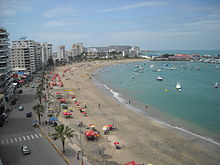
The main attractions in Salinas are the beaches. There are several excellent stretches of gorgeous white sand beaches all along the city's coastlines and there are many high-rise condos and resorts right along with them. You can stay right on the beach in style, to hit the sand every day you're there. Some of the hotels are pricey but you should be able to find some beach-front accommodations to fit most budgets.

Actually, Salinas kind of reminds me of Cartegena, beach-wise, minus the prostitutes and uber-aggressive street vendors. It has long stretches of high-rise condos backed up right to the sand, making a stay an almost religious experience in sun-kissed, drunken debauchery. Okay, that's an exaggeration, since lots of families come here too.

If sunbathing isn't your thing, you can get active at the beaches instead. The surfing is excellent in and around Salinas, and people come from all over to ride the waves. One of the beaches just south of the city, Punta Carnero is especially famous for its waves and many competitions are held there. Add in loads of deep sea fishing, whale watching excursions along with the usual rounds of para-sailing and paragliding

But if you want to stay within the city, check out San Lorenzo Beach. It's the largest one in Salinas and right in the middle of the city. Farther out on the peninsula, you can find Playa del Mar Bravo and Playa de Chipipe. Walk along the busy streets or the beach boardwalks and see the life of Salinas bustling around you. I love to go on some long, slow runs in the morning.

And while I mentioned it before, I'll emphasize it again, there is also some excellent whale-watching outside of Salinas. We are talking world class whale watching in Salinas, since many breeds like Humpback Whales and others migrate right past Salinas twice each year. Several tour groups will offer boat charters to get you out on the water and on the lookout for the next pod of whales to crest the surface. If you stay closer to shore, you can take in some snorkeling or scuba diving. The water is just buzzing with activity - and yes, it is warm water!

By the way, when I go to Salinas I practically live at the Cevecheria. This is an area about two blocks in back of San Lorenzo Beach with two solid square blocks of restaurants all selling ceviche in all of its forms: my wife loves shrimp, but I love Ceviche Mixto - a dish filled with fish, shrimp, squid, and about every other sea creature they can find that day. It is normally served with popcorn or patacones (fried plantains) or plantain chips. Drink with a glass of Pilsener or Club, two of the local beers, and you'll be feeling good.

The Museum of the Great Peninsula is one of the larger attractions in Salinas (after the beaches of course). It's also called the Siglo XXI Museum (21st Century Museum), though it does hold a lot of ancient artifacts, not just contemporary exhibits.

When you're finished with all the sights and activities in Salinas, you can set out on a road-trip up the coast along the famous Ruta del Sol that goes up to Manta from Salinas. Lots of small villages and beaches along the way, as well as the Machalilla National Park. Along the way is the tiny seaside village of Montanita - which has become an Australian surfer hangout because of the waves there. The beaches tend to be stoney here, but with consistently great waves. After playing in the water there are thatch-roofed dives like the Wipe Out to eat ceviche, drink beer, and share the events of the day.

It's easy enough to get to Salinas if you want to add this city to your travel plans. There are major roads coming from Guayaquil, and the General Ulpiano Paez Airport is right in Salinas if you prefer to fly in although commercial service is extremely limited. Most people do drive, and the scenery between the cities is stunning.

Friday, August 2, 2013

Where is All the Fruit in Ecuador?

Just sitting on my patio and looking out to my back yard gives me a gentle reminder of what I love about Ecuador: two coconut trees, three of banana, four papaya and two mangos offer their shade and their fruit to my wife and I. In fact Ecuador as a whole is the source to a long list of great fruits and vegetables. So why does the typical lunch include huge servings of white rice and pureed potatoes?

Even the international fast food chains have jumped on the rice and beans bandwagon. You can get these two staples as side dishes at such junk food giants as KFC though the infamous McDonald's has stuck with its standard North American options.

Though the specific delicacies of Ecuador vary from region to region, there are some things you're going to find in just about any restaurant across the country. That's assuming you stay away from the "American food" places in big hotels and start looking for some authentic and fantastic Ecuadorian food.

Most meals are going to revolve around a soup and a rice-based dish. Sounds plain? Well, you'll still find more variety than you can possibly sample. Soups are broth or cream based, and can be loaded with meat, fish or vegetables. Typical Ecuador vegetables tend to lean to the starchy side, like plantain, potatoes, cassava and yucca. But many meals are served with asparagus, broccoli, and other familiar greens.

The meats served with rice are usually chicken or pork, but you can't ignore the more exotic cuy (known more commonly as the guinea pig). And speaking of cuy, here are a few of the "must try" dishes in Ecuador cuisine:

Cuy (Guinea Pig)
Yes, you did read that right. One of the most traditional meats in Ecuador is the little guinea pig. It can be served up in many different ways, but roasted or grilled whole is the most common. Find some cuy from a street vendor, and you'll be tasting one of Ecuador's most famous signature dishes. Just be prepared to enjoy the entire beast. It's typical to eat the brains, feet and everything in between. Eating whole cuy is a bit of a challenge due to all the bones so you'll have your work cut out for you, and it's not the cheapest meal on the menu. Still, you can't go to Ecuador and not have cuy at least once. And in case you're curious, the meat kind of tastes like duck.

Ceviche
This is another dish that Ecuador is famous for, though it is more of a coastal thing. If you're staying in the highlands, it might not be on the menu as often. It's a cold soup made with a mix of fish, other seafood and zesty lime juice. Try it as a starter before your main meal.

Llapingachos
One last treat that you should have on your list of things to eat in Ecuador is the llapingacho. It's a pretty simple little snack of a fried potato and cheese patty. Sounds simple, but it's very tasty and available just about everywhere.

Back to my original question of "why?" so little fruit and vegetables, I'm not sure I can really pin down an answer to that. It's mainly due to the economy for the average Ecuadorian. When there isn't much money around, you choose the cheapest and most filling foods out that and that usually means starches (like rice, yucca, plantains), beans and a few local meats. And so, the cuisine of Ecuador has been built around these humble foundations.


Now, I really can't say that there is no fruit in a typical Ecuador menu. A whole mix of wonderful fruit juices and smoothies are available just about anywhere you go. You can sample a whole new range of sweet juices that are virtually unheard of in North America. Try a fresh glass of maracuya, guanaba or tomate de arbol (tree tomatoes). You won't be disappointed. If you prefer something more familiar, you'll find lots of  drinks with mango, papaya, coconut and pineapple juices, too.

Monday, July 29, 2013

More Problems at Hostal de Monasterio

Well, I guess I am not the only one who has found the Hostal de Monasterio in Cuenca, Ecuador, to be lacking. If you missed it, I made the following post about my reservation fiasco. I showed up and no one at the Hostel was there. Now, I've heard from another person that she had the very same experience.

Bea told me that several weeks ago she also had a reservation for Monastario for herself and some family members. Just like me, when they arrived the place was closed. Folks around the place told her that it was often closed when it was not busy. Just like me, her group ended up finding rooms at another place nearby.

The good news is unlike me, they didn't get locked inside the building by a wayward locksmith. Still, my advice from before applies. Make sure you call to verify everything is set for your reservation, and that everything will be open when you are scheduled to arrive/

Monday, July 22, 2013

No Room at the Cuenca Monasterio for Me

No, there is no room at the Monasterio for me in Cuenca. In fact, there is no body at all at the monastery. This was one of those sad travel misadventures that fortunately I experienced entirely alone. I have come to Cuenca, Ecuador, one of my favorite places on Earth, to do some decompressing, some photography, do a little research for some travel articles and just have a nice break from the normal.

This time I took a bus from Guayaquil. It was late getting airline tickets so the short flight would have cost $140 round trip. I opted for the bus because it is only $8.25 each way for four hours travel time. Besides, I wanted to view the wonders of the Andes as we climbed from the sea level mangrove swamps of the Ecuadorian Pacific Coast up into the Sierras and past Ecuador's Cajas National Park.

You know, sweeping vistas.


Tumbling streams.


Llamas crossing the road.

Just stuff you don't get when soaring over head in a plane at 18,000 feet.

Anyway I am super excited because I have booked a room at the Hostal El Monasterio. This advertises itself as a higher end hostel located in an old monastery in Cuenca. History nut that I am that equals being way so cool.

I arrived at the monastery, which is in the old town district of Cuenca (El Centro). I find that the hostel is on the 6th floor.

By the way, for those unfamiliar, in Latin America the ground floor is Planta Baja. The next floor above the street is Piso Primero - 1st Floor. The Hostal El Monesterio is on the 7th floor by us Gringo's reckoning. There is an elevator, but it is not working.

Cuenca is at about 2500 meters above sea level, or more than 7500 feet. I am dragging my one pack with clothes, another with camera equipment and my laptop as well as a seperate tripod. By Piso Tercero (3rd Floor) I'm wheezing.

As I get past the 5th floor I begin to hear a TV. I come around the final set of stairs and see a security gate closed. On the other side I see:

Yep its the place. Several signs showing it is the Hostel de Monasterio. But no one here. I set down my bags and wait a minute for my lungs to stop wheezing. Then I call. I bang. I knock. I yell. There I am, one side of a security gate. On the other is nothing but a TV.

For 30 minutes I wait and make noise but no one is home at the Monasterio. Would a clerk be sleeping at 2:00 pm in the afternoon? Finally, defeated, I heft up my bags and clump down the seven flights of stairs.

To find the security gate to the building has been latched and locked. I am now trapped.

I call. I bang. I get out a plastic card from my wallet to try to jimmy the bolt latch but it is too heavy duty for that and I merely manage to shew up an otherwise worthless card. People on the street go buy, looking at me quizzically.

After another five minutes a man comes buy, a locksmith. He had closed the gate because he was working on the lock. As I stood there steaming, he calmly took a file to a large key he had with him and spent several minutes doctoring the key up. Finally he inserts the key and releases me from my prison.

And by the way, still no one at the hostel and no one can tell me if and when anyone will ever come by. The locksmith is working for the owner of the building and as far as he knows everything is closed on this Monday.

So with most of an hour now wasted and the afternoon getting on, I heft my load and stride out, Surely there is someplace in Cuenca today I can lay my head?

Because there is no room at the monastery for me.

Monday, July 15, 2013

Travel Alert! Ecuador Volcano Tungurahua Erupts!

This has just been sent out by the US embassy in Quito:

Security Message for U.S. Citizens - U.S. Mission, Ecuador
Volcano Tungurahua Erupts, Caution Advised when Traveling in the Area

July 15, 2013

The U.S. Mission in Ecuador advises U.S. citizens living or traveling in Ecuador that the Tungurahua volcano, located near the tourist community of Banos in central Ecuador, reactivated on Sunday, July 14, 2013 with a period of high activity that included emissions of ash and pyroclastic flows (fast-moving currents of hot gas and rock).

Ecuador's National Secretary of Risk Management has imposed an Orange level of alert (the second highest level) for the provinces of Tungurahua and Chimborazo (including the town of Banos). In some communities immediately adjacent to the volcano, voluntary evacuations have been implemented. Ecuador's Geophysical Institute reports ash discharge has been registered in the provinces of Tungurahua, Chimborazo, Bolivar, Los Rios, Manabi and Guayas.

A thin layer of coarse black ash affected the city of Ambato in Tungurahua province. The most affected areas were the central and southern part of the city.

Past eruptions have affected air travel in Ecuador. U.S. citizens planning to fly to, from, or within Ecuador should monitor news outlets and have a plan in the event of flight cancellations. Some airlines have already canceled individual flights as a precautionary measure.

Because Ecuador is in a region of frequent volcano eruptions and earthquakes, U.S. citizens residing in Ecuador should keep extra food and water at home and consider purchasing dust masks and heavy gloves to protect hands during ash clean-up.

For more information on current activity, visit the website of the Ecuadorian Geophysical Institute, which monitors volcanoes and earthquakes.

Americans living or traveling in Ecuador are encouraged to enroll with the nearest U.S. Embassy or Consulate in order to obtain updated information on travel and security within Ecuador through the Department of State's Smart Traveler Enrollment Program.

U.S. citizens should consult the Country Specific Information for Ecuador and the latest Travel Alerts and Warnings and Worldwide Caution at the Department's website. Updated information on travel and security in Ecuador may also be obtained from the Department of State by calling 1-888-407-4747 within the United States or by calling 1-202-501-4444 outside the United States.

The U.S. Embassy in Quito is located at Avigiras E12-170 y Eloy Alfaro. The telephone number for American Citizen Service (ACS) inquiries is (011 593-2) 398-5000. Within the same city use the last seven digits. Add the city code for intercity telephone calls.

Public call-in hours are Monday through Thursday 8:00 to 10:00 a.m. and Friday 10:00 to 11:00 a.m.
For after-hours emergencies, contact the Embassy at (011 593-2) 398-5200. Appointments for ACS are available through our website.

The U.S. Consulate General in Guayaquil is located at the corner of Avenida 9 de Octubre and Garcia Moreno (near the Hotel Oro Verde). The telephone number for ACS inquiries is (011-593-4) 232-3570 during business hours, 8:00 a.m. to 5:00 p.m., or 232-1152 for after-hours emergencies.

Saturday, July 13, 2013

Globalization Goes Latino - Eat Local

I walked into the newest mall here in Guayaquil to see just how far globalization has come. First the name – City Mall! And then the food court, where I can eat such Latin American classics as: Subway, KFC, Pizza Hut, Quiznos and McDonalds. By the way, I can go around the corner for Burger King, Tony Roma’s, TGI Friday’s and Chili’s. Are there any Ecuadorian restaurants left in Ecuador?

Of course, these are all mall food-court staples but couldn't they find at least a few local fast-food places to join the ranks of these international chains?

I'll admit that there is a nice bit of comfort knowing that in a strange country, you can stop in a familiar place and have the exact same sandwich you get when 2 blocks from home. But as these white-washed restaurants start to force out the smaller and more authentic Ecuadorian places, it starts to drag down the appeal of any nation. Who wants to travel somewhere only to be surrounded by the same things as home? It kind of defeats the purpose, doesn't it?

To be fair, some of these franchises do offer a little Latin American cuisine hidden away in their standard menus. You can get a serving of rice and beans as a side at KFC. Other than a few added extras, the menus are mostly all North American. Of course, by its very nature, fast food is generally not supposed to be any sort of representation of quality cuisine. I mean really, nobody goes to any fast food joint because they want traditional or home-cooked meals. So if you are looking to find some good Ecuadorian food, the mall isn't the place to find it.

To get real Latin American food in Ecuador, find restaurants that serve up fresh bowls of tangy seafood ceviche, cheesy crisp llapingachos, fried plantain slices, or rich goat stew (Seco de Chivo). The ultimate culinary experience in Ecuador is to experience a whole roasted cuy (guinea pig) purchased from a street vendor. That's a bit more interesting eating. But do they have to keep the teeth and claws on it when they roast and serve it?

Not only will you find that these dishes are far more delightful than the typical mall-food fare, the prices are usually quite a bit more reasonable. Don't feel that getting authentic food is going to be too expensive. That's actually where the better deals are found.

I'd love to be able to direct you to the "best" restaurants to find some excellent Ecuador food, but there are so many to choose from that I really can't list them all. Since I started off mentioning Guayaquil, I have a few suggestions for visitors. Embarcadero 41, El Cafe de Tere and La Canoa all have amazing local dishes.


So next time you are in Guayaquil (or any other city in Ecuador), try to find someplace unique to eat rather than settle for the closest outlet of Carl's Jr or Domino Pizza. Your stomach will thank you.

Tuesday, July 9, 2013

Isla de la Plata – The Poor Man’s Galapagos

Yes, the Galapagos Islands are on almost everybody’s bucket list. They should be, even if Darwin didn’t make the islands famous. Their unique mix of breathtaking island views and fascinating plants and animals are a lifetime experience. But it also costs, a lot, with triple digit park fees alongside high costs for air travel and jaw dropping hotel charges. But Ecuadorians know that Isla de la Plata is much more accessible and much cheaper. You can even see boobies.

It's off Ecuador's Pacific coast near the Machalilla National Park, and the tiny village of Puerto Lopez is the place to get a boat. If you're seeing the park, you really must take the extra time to head out to Isla de la Plata as well. It's is nowhere near as busy as the Galapagos and you'll see just as much (possibly even more). You can get admission tickets that include the island along with your entry to the park, and there are nearly a dozen different boat operators that run out there.

It may be small but this island is a true gem, surrounded by rocky coastlines and the deep blue ocean. There are footpaths circling the island so you can see all the landscapes without having to blaze your own trails. Guided tours are an option too if you want to hear a professional naturalist tell the island's tales.

The main attraction here are the boobies. More boobies than you could possibly count. The feathered kind, of course. The blue-footed and red-footed boobies are the most numerous and you won't see both species together even if you did visit the famous Galapagos instead. That's unique to Isla de la Plata. There are also masked boobies, pelicans, albatrosses, and the brilliantly red-chested frigatebirds. The birds are pretty tame after so many years of watching all the human visitors, so you can expect to get close to them while you walk the trails.

Though Isla de la Plata is a bird-watchers paradise, there are other animals to be found. Most notable are the groups of sea lions you can find lounging around the shores. It's the birds that make up most of the island wildlife though. This is also a prime whale watching destination.

And there is more to see off the island itself if you don't mind getting wet. There are several great snorkeling locations where you can watch shoals of ocean fish and maybe see a giant sea turtle. Manta rays are also populous around the island, and they are a thrilling sight to see from underwater. Most tour groups will offer the option to snorkel so don't worry about arranging your own gear or anything. And even a complete novice can try it out at least once.

When you're on the boat coming or going to the island, watch the water for a cresting humpback whale or even a pod of dolphins or Orca whales. The boat ride is about an hour long, so you'll have plenty of time to watch the waves. Whale sightings are a bit seasonal, with the best viewing between June and September.

And as if that wasn't enough to fill a day, the beaches along the Ruta del Sol are waiting for you south of Puerto Lopez back on the mainland. The beaches are lined with white sand, and offer fine spots for sun-bathers and surfers alike. A drive up the coast will bring you to these beaches, as well as several little villages and an archaeological museum in the town of Valdivia. It's the perfect place to relax a little after your trip to the island. Don't forget to sample the local ceviche!

Tuesday, July 2, 2013

Taxis – How to Be Safe

Taxis are great for travelers in South America. In most places they are numerous and cheap. In my city of Guayaquil which is over two million people you can go almost anywhere from between $2-$7. However you can be cheated, and even robbed or kidnapped if you get yourself in the wrong situation. A couple of weeks ago a co-worker and his girl friend were the victims of a "sequestro expreso" (quick kidnapping). The got into a cab and almost immediately the cab filled up with armed men. They were forced to go around to different ATMs to drain their credit cards. Of course they lost their wallets and all other money and valuables. 

Several hours later they were released physically unharmed. They were smart, they did not resist. Others have been beaten, raped and even killed when they resisted. I've known several who have been kidnapped this way over the years. I have not, which I out down to a combination of always practicing good awareness and personal security practices, but also some good luck.

Here are some smart guidelines on how to use taxis confidently and safely in South America.

Ask the Hotel
The staff at the front desk of your hotel should be able to help you find some reputable taxi service, so talk to them first. In fact, you should probably ask them to call a taxi for you rather than try to hail one out on the street. That way, you know that you're getting car from an actual taxi company. This is also a tip that you should follow when you're away from the hotel. Know the number of a good cab company and call for one when you need to go anywhere. It may take a little longer than grabbing the first car that drives by, but you never know who you're getting in a car with that way.

You can also ask at the desk about which areas of the city aren't very safe for tourists, and where you should avoid. Now, you probably won't have any particular reason to be heading to the "bad side of town" but it doesn't hurt to know where you should steer clear of.

If you are in a city with a consulate, like Guayaquil where I live, you can also inquire at the consulate if they have any vetted or approved taxi services. They often have 1-2 services they use for their personnel and activities. However the downside is these companies often are very busy and not always available just for people who call up.

Most airports, shopping malls and other important businesses have approved taxi services they work with and these are almost certainly safe. However on the fringes of the properties are often other taxis, some are good but this is also where the dangerous taxis lie.

Know the Rates
This can be a bit trickier, but with a little research, you should get to know what a typical taxi rate should be around the city. That way you can tell when your driver is trying to rip you off. Another side of doing some research beforehand is that you should have a rough idea where you're going, and watch as you travel. If your driver starts heading in the wrong direction, you'll want to notice as soon as possible.

Keep Your Stuff to Yourself
You'll most certainly be carrying something with you when you're sight-seeing from a small backpack to a purse. That's fine, but don't sit rifling through it or leafing through your wallet while sitting in the cab. Don't pull out your laptop computer while en route. Flaunting your wealth is never a safe idea.

Recognize the Share Taxis
These type of taxis aren't common in North America, so people are sometimes a little confused if they get into one. Depending on the region, they are called taxi colectivos or just colectivos, and they run more like a shuttlebus than a typical taxi. They follow a set route and you share the it with whoever else is going that way. They are much smaller than a public bus, sometimes just a little pickup truck, and don't usually run on a set schedule. The driver prefers to go once the car or van is full, so you can expect a bit of waiting if nobody else is traveling at that moment.

I love using share taxis and buses when I travel within the country. You see much more, meet more people, and learn a lot about real life and culture than otherwise. They are a great way to travel but you need to be aware that you'll be sharing close quarters with several other people during your trip. My wife was robbed on one. She was traveling and dozed off. When she woke up all of her back pack zippers were opened and her wallet was missing. No one saw anything, of course. If that doesn't appeal to you, stick to the traditional exclusive taxis. 

Monday, July 1, 2013

Steaming on Snowden

So here I am in Ecuador, an American Expat, and now I find myself as an object of intense debate and curiosity. The Expat chat rooms are crackling with opinions on Edward Snowden and what it all means to us Americans living here in Ecuador. Meanwhile almost everyday an Ecuadorian asks me what I think. I've stayed out of it. But today I read a statement that simply makes me want to scream. So here it is. I am Steaming on Snowden.

For those for you who just  returned from your three month vacation on Mars, Edward Snowden is the ex-CIA worker cum NSA contractor who  filched several laptops worth of classified documents. Since then we have had a wild party of embarrassing newspaper leaks, Snowden on the run, being helped by WikiLeaks and their cornered head Jullian Assange, and the young man ending up in a no man's land at an airport in Moscow. Originally a whole raft of countries, headed by Russia and Ecuador, trumpeted Snowden and the embarrassment he has caused the US government, but as the initial ha ha has given way Snowden found himself with no visa, and no country seems to want him, except of course the United States which is waiting with a pair of handcuffs.

And I have been, well not ambivalent, but torn on the issue. On the one hand I am an ex-military guy. I take things like being sworn to secrets seriously. Especially since there are news reports from Hong Kong that quoted young Snowden as having applied to his secret job with the express purpose of stealing secrets. That makes my blood burn. On the other hand, I am also not at all happy with the recent policies of the Bush and Obama administrations. Their records on civil rights and privacy have also made my blood to boil.

So with my blood boiling and burning I kept my mouth shut, because to condemn one might seem like condoning the other. I was in no mood to condone anything. Until now. I still do not really condone, but I have some heartfelt condemnation to ladle out.

This afternoon I ran across a news item on CNBC.com. You can see the entire news report HERE.

The key items were two quotes. These are reportedly made by Snowden and presented by representatives of WikiLeaks:

First of all, the report says that Snowden criticises the US Government for pressuring other governments to deny his asylum petitions.

Quote #1
"This kind of deception from a world leader is not justice, and neither is the extralegal penalty of exile. These are the old, bad tools of political aggression. Their purpose is to frighten, not me, but those who would come after me,"
Quote #2
"Although I am convicted of nothing, it [U.S. government] has unilaterally revoked my passport, leaving me a stateless person. Without any judicial order, the administration now seeks to stop me exercising a basic right. A right that belongs to everybody, a right to asylum."
My first thought is this kid needs to go back to high school.

Deception from a world leader??? Really? It looks to be pretty plain here. The US is angry and wants Snowden back. Can anyone anywhere in the world think that the US is deceiving people and really does not want Snowden back??? 


The extralegal penalty of exile - Eh - you went into exile, dear Edward. If I went merely by your actions I would have had to say you were wanted for raping and killing a girl or you stole state secrets. Oh! It was state secrets. Well, either way it was your choice to go. You cannot in any way blame the US Government for your own ineptitude. They do enough stupid things without you blaming them for what you did.


These are the old, bad tools of political aggression. Their purpose is to frighten, not me, but those who would come after me, Well, duh.


Let me tell you who my heroes are: George Washington, John Adams, Martin Luther King Jr, Nelson Mandela, Mahatma Gandhi. What did they have in common? They were willing to sacrifice themselves for a cause they believed in.


George Washington and John Adams joined the Colonials in their war against Britain knowing full well that if they were caught or unsuccessful that they would be shot, maybe hanged and if King Geaorge was really feeling put upon they might have been drawn and quartered. They did it anyway, believing it was the right thing to do.


Martin Luther King Jr was thrown in jail several times for his activities in fighting against segregation and  discrimination. By the way I think everybody in this wretched fiasco should be required to sit in a corner and be required to read twice over King's Letter from Birmingham Jail.


Mandela and Gandhi were both thrown in jail and repeatedly beaten for their fight for justice. They did it anyway, accepting their punishment as a cost of change.


Why do I have a slow burn against Assange and Snowden? Because they have a hypocritical, bankrupt view of struggle for freedom. They think the only thing that should be required.is that they unilaterally decide they are innocent of all crimes. It was a policy that first came from a guy by the name of Lenin: "The ends justify the means." It is the same crime they charge against Obama and the US government. It is a bankrupt idea, morally empty. The end can never the the justification of the means.That way leads to the harsh mockery of the Iranian courts. I wonder what Snowden would think his fate would be if he had done this as an Iranian citizen against the Iranian govenrment? The end truly justifies the means there. Is that the society Snowden wants?


Washington, Adams, King, Mandela and Gandhi broke the unjust laws, true, but then they stood and were willing to take the punishment. They showed their moral courage, sure in their expectations that history would prove them right.What do you have if there is no punishment for committing crimes? What if the person who commits the crime simply needs to say they committed their crime for freedom or liberty and so all of society must stop and not give them any punishment? If that is all a person needs to do then freedom and liberty and laws and justice are nothing but a farce.


Yes the laws are there. Yes the US government is trying to capture Snowden. To tell you the truth they should. Laws should be followed, unless they are unrighteous  then they should be changed. They must not become a mockery if anyone can ignore the law simply on a whim. There are lots of societies in this world where there are people who do not have to follow the laws of their own country. Of course, these countries are blindingly corrupt and shot through with inequalities and economic, political and social discrimination. Why should Snowden be allowed to break the law, simply because he assures us that he is doing it merely as a patriotic action? That we should take his word that all the scheming and lying he did to get into that classified position was for freedom?


If Snowden and Assange really are patriots and heroes then things will change and history will show them to be heroes. But not everybody can be a hero. You have to sacrifice to be a hero. Snowden and Assange want to be heroes without sacrifice. And that is why the two of them are laughable, pale caricatures of heroes like Mandela, King, Gandhi, Washington and Adams.

.
Unilaterally revoked my passport, leaving me a stateless person - Duh. The passport is not a right, it is something that is granted by a government. In fact, a passport is not owned by the individual. By international law and treaty a passport is owned and controlled by the government who issued it. In my passport, the one I have open in front of me, IMPORTANT INFORMATION REGARDING YOUR PASSPORT. it reads the following 
US GOVERNMENT PROPERTY this passport is the property of the United States (Title 22, Code of Federal Regulations, Section 51.9). It must be  surrendered upon demand made by an authorized individual of the United States Government.
Of course it was unilaterally taken. Snowden violated an oath, stole documents and property, committed multiple felonies, knew he was committing multiple felonies ( the briefings you get about it when you get such a clearance are extremely detailed). Of course the United States government unilaterally revoked the passport and his security clearance too. It is not something the government would simply say:

GOVERNMENT OFFICIAL : Sorry, we cannot let you travel, so can we have our passport back?


SNOWDEN : No. I am going to leave and find a nice warm beach somewhere..


GOVERNMENT OFFICIAL : Oh, come on! Be a nice guy. Please let me have your passport puhlease?


Sorry, I can't see that happening.And this is such an empty, whining, clueless little fart. It's as bad as some of the worst ridiculousness that North Korea was blathering a few months ago. Please, just shut up.


And finally:


Without any judicial order, the administration now seeks to stop me exercising a basic right. A right that belongs to everybody, a right to asylum. Sorry, you just failed your social studies exam. There is no right to asylum. Asylum is a status GRANTED by a government. Every year thousands of people apply to the United States apply for asylum. Some receive it, most do not. It is the same way all over this world and always has been.


And frankly it is this last part which just turned my stomach and left me disgusted with the Snowden/Assange/WikiLeaks side. Theirs is a morally empty, juvenile arrogance in which they are hoping that by doing the most screaming and pointing of fingers  people will be blind to the unwholesome ridiculousness of their empty arguments. They seek to be heroes without sacrifice. They seek the anarchy of destruction without a vision of a better world. They know they are smarter than everybody else and as long as they keep talking then no one will see that they have done nothing admirable.Shut up, shut up, please, just shut up. 


The Bush and Obama governments still make my blood boil.


But Snowden has me steaming.


Saturday, June 29, 2013

Climbing Cerro Santa Ana

Sweat is dripping from my nose and I look down. The marker on the step ahead of me reads 289. There are 444 steps to reach the top of Cerro Santa Ana and its penultimate lighthouse. That’s, err, 155 more to go. It’s time for another break so I step into another door, another funky bar with cane chairs, order a cervesa (beer), my third so far this Saturday afternoon. I sit and watch the scores of people going up and down the steps. I have all day.

Most visitors to Guayaquil's highest tourist destination see this as a somewhat painful chore, and inevitably try to march up all 444 steps like they're trying to win some kind of marathon. They fail to see that the point of Cerro Santa Ana is the journey, not the destination. I like to come here every 3-4 weeks, especially on a Saturday. It is great exercise, I can take some photos, and just enjoying life and reveling in the moment is refreshing all by itself.

The entire route up to the peak is lined with brightly colored shops, boutiques, art galleries and restaurants, so there is no reason why you shouldn't stop and browse every few steps. It so much of the Latino culture in general, and the coastal Ecuadorian culture in particular, where taking your time, stopping and browsing and drinking in the location to its deepest, richest level is really the whole point.

When you only climb up 15 or 20 steps at a time, you won't feel like you're climbing at all. Just make sure to allow yourself lots of time and don't worry about how long it is taking you. Even if you are just sitting on a bench, you could always strike up a conversation with someone next to you and get to know another traveler or a local who might have some great Guayaquil stories to share.

Even at such a relaxed pace, you will eventually reach the top of Cerro Santa Ana, to find some of the most amazing views in Guayaquil. The hill is covered in a cluttered and colorful mix of homes and shops, making the sight a little unexpected. The sides of the hill always remind me of some architectural Easter Egg decoration. It's beautiful.

The old Fortin del Cerro (the Fort of the Hill, in English) still stands to remind us of the times of battles and pirates. You can see the old fort, and there is a bit of a museum in there now where you can learn a bit more about Guayaquil's past. Nothing wrong with a little learning during your sight-seeing.

There is also a lighthouse where you can climb just a few more steps for the ultimate panoramic view of the city as well as the river. A small Spanish-style church is also at the top, so you'll find several historical parts of Guayaquil to explore once you're at the summit.

Once you're back at the base of the hill, you can see some other Guayaquil sights like the old Church of Santo Domingo or the Teatro Bogota theatre.

So if you're up for the challenge of Cerro Santa Ana, you'll have no trouble finding it. It's visible from anywhere in the city and you can get started on the steps right in the heart of the city. You really have no excuse. Get climbing.

Friday, June 28, 2013

They Do Parks Right in Guayaquil

I think Guayaquil has some of the best parks in the world. Of course, I have lived here for seven years so I might be a bit biased. Guayaquil is also one of those cities that never seems to get any respect. It is the largest city in Ecuador and the commercial center and a major port. I hear a lot of people who say there is nothing to do here. In Guayaquil? 

En serio? 

(really?)??????

Most people only know it as a stop along their trip to the Galapagos Islands. Step out of the hotel, though and you find a wonderfully green world out there.

Let's start by exploring Iguana Park first. It's just a few blocks from the riverside boardwalks of Malecon Simon Bolivar, so a quick detour from your shopping will bring you to this little green city gem. What makes Iguana Park so special is that the name is so wonderfully accurate. This little city park is filled with huge docile iguanas, that laze around all day regardless of their human audiences. Iguanas are harmless and are fun to watch after seeing all the nearby city attractions. There are also snapping turtles in a pool. By the way, one thing you’ll find is about every park has some massive statue to some hero or local legend. At Iguana Park it is Simon Bolivar.
Though most people call it Iguana Park, it sometimes goes by the name Parque Seminario.

And if you are walking along the Malecon 2000, there is another great park at the northern end of it. Just make sure you're ready for the 444 steps it takes to get up to the Cerro Santa Ana. The view over the city makes the extra effort worth it though. You can see everything from up there, and its more than just a simple park. There is a lot of history at Cerra Santa Ana, including an old lighthouse, church, museum and high watch battlements. But to me the best part are the scores of little restaurants, bars and stores along the winding steps.

If that's not enough history to suit you, you should spend some time at the Parque Historico, across the river from the downtown core of Guayaquil. It's a real authentic step back in time, where you can walk around restored buildings from Ecuador's past. The little zoo boasts a collection of brightly-colored parrots, more iguanas and other local wildlife. It's a great park to visit if you are travelling with children because there is so much to see.

Personally I love the Malecon 2000. Besides being a fabulous place to see the river, there are loads of little vendors and shops to explore as well. Museums and restaurants are also found along the boardwalk, but if you are looking for parks then its the Malecon Gardens you're after. The gardens are a huge botanical park filled with Ecuadorian landscapes. Large groomed beds of flowers line the pedestrian pathways, and you can stroll through the area under a green canopy of trees. Streams, fountains and gazebos dot the area to add a little extra interest. It's just a beautiful place for a relaxing afternoon walk.

This is just the tip of the iceberg. There are many other parks in Guayaquil so that you could easily find a new patch of green space every day you are there, and never see the same sights twice. 

Thursday, June 27, 2013

I Hate Baggage Fees

Coming back home from a short holiday back in the United States I boarded a plane to take me from Las Vegas to Panama City. Copa Airlines weighed all of the passenger carry-on baggage to make sure they were within baggage restrictions. Yes, it is true, the insane baggage fees and regulations are stretching their ridiculous tendrils into Latin American travel.

It's getting to the point where isn't almost tempting to travel empty handed and just buy new clothes at your destination. Well, it's not quite that bad yet, but it's getting there. If you are planning a flight to South America, make sure you know what to expect with baggage fees and regulations.

Of course, with the long list of potential international and specifically South American airlines in business these days, I can't be too specific and list off all the current fees and regulations for them all. That fact alone is a bit of a shame in itself. Travel shouldn't be so complicated.

Many large airlines will now only allow you to check one single piece of luggage for free (you usually still get a little carry-on as well). American Airlines are one good example, though they will allow 2 free checked bags if you are heading to Brazil or Peru. I'm not sure why the specific destinations makes a difference. Delta and JetBlue are the same, only allowing a single bag for free.

More generous airlines let you take on 2 bags before they start to tally up extra costs for you. British Airways, Taca and LAN Airlines allow for 2 checked bags. Copa Airlines is pretty unique. Even though they took the time to weigh and measure all of my bags, at least I was able to take on as many as I needed. They don't have limits on the number of checked baggage items, only on the weights and sizes.

These limits are all based on the standard economy class available with each airline. If you want to pay the big bucks to travel first- or business-class, then you will likely be allowed an extra bag or two.

HINT: Sometimes last minute flights with openings in 1st Class will allow a cheap upgrade. a couple of years ago US Air let me upgrade from economy to 1st class for only $50, which allowed me two extra bags. Ask at the check in desk.

You can sometimes find a bit of a loophole if you are travelling with children. In many cases, airlines allow for 1 piece of luggage for each child under 2. Depending on how much you need to carry for child, this may allow you a bit of extra space for your own stuff.

DANGER! - Since we live in Ecuador, but frequently travel to the States - we run into the problem that domestic US baggage policies are ore restrictive than international. For example, right now my wife flew from Guayaquil to Las Vegas. Later she has to go from Las Vegas to Orlando, then after attending a conference, she goes home (my wife has such a tough life). Well, the flights to and from Guayaquil fall under international rules - ie more and heavier bags and cheaper fees. But that Vegas to Orlando link is considered domestic. That's right, even though it is all the same booking the rules change. 

It depends on where you start and stop that day's trip. If either part is international, then you go by the international rules. However if both ends for the day are all in the States - then you pay more.

What makes it worse is that the fees for your next bag aren't cheap either. They used to be token costs but the price tag is getting serious. You can easily pay over $50 just to check one bag beyond your limit. In many cases, that just means your second suitcase. Similar fees are enforced if your bags (including any free bags) are over-sized or overweight. So, if you had 2 bags and you managed to have them both slightly too heavy, you could be charged $50 just for having a 2nd bag and then $50 each for both being overweight. that's an additional $150 that your flight is costing you.

Before any trip, always consult your airlines website to find out the current regulations. There is always some page hidden amongst the website pages where it lists out the rules in painful detail. These rules change all the time. So do not assume simply because you've flown one on one airline that you know all of the rules. Best to check each time.

And never just guess about the size or weight of your checked luggage or carry-ons. They likely will be weighed or measured and it will be a bit of a shock if you realize your baggage gets disallowed, or costs you a hundred dollars to take with you. Close isn't good enough, keep everything under the limits. My wife picked up a little hand-held weight scale and it always travels where ever we are about.

Saturday, June 22, 2013

Quito Tababela Airport - Not Much of an Improvement

Quito now has a modern international airport, with the new Tababela replacing the old and cramped Mariscal Sucre. True, Tababela is new, modern and gorgeous to look at. I have to say that there is a lot more bad then good. Flying into and out of Quito is now a lot tougher.


The main hassle is just getting to the airport in the first place. They planned for future expansions of Quito, which was probably a smart move, except that it means the airport is more than an hour outside of the city if you're getting there by taxi. In fact, you'd be wise to plan on a 2-hour trip to be on the safe side. That can mean a price tag of nearly $30 on top of your wasted time.

You might wonder about all this when you realize that the Tababela airport is really just 14km away from Quito.  How can that mean so much extra travel time? You have to understand that the traffic between the airport and the city is extremely busy, the roads are not very direct and there is a particularly nasty bottle-neck at a narrow 30-year old bridge along the way. 

There are plans for a cheaper shuttle that will take travelers between Quito and the new Mariscal Sucre International Airport, which can save you a little money but won't help the waste of time on the roads. In fact, it will probably take longer than a regular taxi would.

Now, this isn't just a problem for the usual international traveller who is coming to Quito. It is starting to effect domestic travel around the city as well. Considering how far it is to drive to the new airport, people are choosing to just drive to their destinations instead of taking any short domestic flights. The Guayaquil Airport is becoming a more convenient arrival point for some routes and people are just avoiding Quito completely. Apparently, there has been a 30% drop in domestic travel through Mariscal Sucre International Airport, and it's only been in operation for less than a year. Not a good sign.

The location for the new Tababela Airport has led to other problems besides transportation. The low-lying site is prone to foggy weather, and you can imagine what that does to a major international airport. Delays are becoming more and more common, though this is usually only an impact during the December to May time frame. It might be a good idea to avoid this time of the year if you like knowing when your plane is going to land. At least plan with lots of extra time in hand in case of delays.

And even though this airport handles a large majority of all international flights to Ecuador, they decided to make the terminal smaller with the new airport. Not only is it smaller and has fewer seats for waiting passengers, there are fewer check-in counters too. I can't figure out the sense of actually shrinking an airport when dealing with such an international scale, but that seems to have been the case. Major airlines like KLM, Delta Air, United Airlines and Iberia all serve the new Tababela airport so you can imagine the crowds.

To be fair, they are trying to fix the transportation problems by improving the roadways between Quito and the airport, and construction is already underway to add new seats within the terminal. Perhaps in a little more time, the new Mariscal Sucre International Airport will actually live up to its potential. Until then, expect more than a few snags when travelling through Quito and plan for some extra transit time.