Showing posts with label ceviche. Show all posts

Saturday, August 3, 2013

Sand and Sun: Ecuador’s Salinas

Guayaquil, where I live, lies along the Duale River and not too far from Ecuador's Pacific Coast. When things get hot, the locals head to either Salinas or Playas. Salinas is more upscale, Playas more for those looking for a closer and cheaper getaway, but in any case there is some great sun and sand experiences in store. I'll talk about Salinas first, and look at Playas in another post.

Salinas is a small city on the south-central coast of Ecuador, and it's a tourist hot-spot for lots of reasons.  
The main attractions in Salinas are the beaches. There are several excellent stretches of gorgeous white sand beaches all along the city's coastlines and there are many high-rise condos and resorts right along with them. You can stay right on the beach in style, to hit the sand every day you're there. Some of the hotels are pricey but you should be able to find some beach-front accommodations to fit most budgets.

Actually, Salinas kind of reminds me of Cartegena, beach-wise, minus the prostitutes and uber-aggressive street vendors. It has long stretches of high-rise condos backed up right to the sand, making a stay an almost religious experience in sun-kissed, drunken debauchery. Okay, that's an exaggeration, since lots of families come here too.

If sunbathing isn't your thing, you can get active at the beaches instead. The surfing is excellent in and around Salinas, and people come from all over to ride the waves. One of the beaches just south of the city, Punta Carnero is especially famous for its waves and many competitions are held there. Add in loads of deep sea fishing, whale watching excursions along with the usual rounds of para-sailing and paragliding
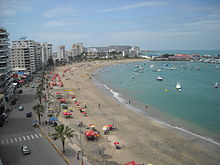
But if you want to stay within the city, check out San Lorenzo Beach. It's the largest one in Salinas and right in the middle of the city. Farther out on the peninsula, you can find Playa del Mar Bravo and Playa de Chipipe. Walk along the busy streets or the beach boardwalks and see the life of Salinas bustling around you. I love to go on some long, slow runs in the morning.

And while I mentioned it before, I'll emphasize it again, there is also some excellent whale-watching outside of Salinas. We are talking world class whale watching in Salinas, since many breeds like Humpback Whales and others migrate right past Salinas twice each year. Several tour groups will offer boat charters to get you out on the water and on the lookout for the next pod of whales to crest the surface. If you stay closer to shore, you can take in some snorkeling or scuba diving. The water is just buzzing with activity - and yes, it is warm water!

By the way, when I go to Salinas I practically live at the Cevecheria. This is an area about two blocks in back of San Lorenzo Beach with two solid square blocks of restaurants all selling ceviche in all of its forms: my wife loves shrimp, but I love Ceviche Mixto - a dish filled with fish, shrimp, squid, and about every other sea creature they can find that day. It is normally served with popcorn or patacones (fried plantains) or plantain chips. Drink with a glass of Pilsener or Club, two of the local beers, and you'll be feeling good.

The Museum of the Great Peninsula is one of the larger attractions in Salinas (after the beaches of course). It's also called the Siglo XXI Museum (21st Century Museum), though it does hold a lot of ancient artifacts, not just contemporary exhibits.

When you're finished with all the sights and activities in Salinas, you can set out on a road-trip up the coast along the famous Ruta del Sol that goes up to Manta from Salinas. Lots of small villages and beaches along the way, as well as the Machalilla National Park. Along the way is the tiny seaside village of Montanita - which has become an Australian surfer hangout because of the waves there. The beaches tend to be stoney here, but with consistently great waves. After playing in the water there are thatch-roofed dives like the Wipe Out to eat ceviche, drink beer, and share the events of the day.

It's easy enough to get to Salinas if you want to add this city to your travel plans. There are major roads coming from Guayaquil, and the General Ulpiano Paez Airport is right in Salinas if you prefer to fly in although commercial service is extremely limited. Most people do drive, and the scenery between the cities is stunning.

Friday, August 2, 2013

Where is All the Fruit in Ecuador?

Just sitting on my patio and looking out to my back yard gives me a gentle reminder of what I love about Ecuador: two coconut trees, three of banana, four papaya and two mangos offer their shade and their fruit to my wife and I. In fact Ecuador as a whole is the source to a long list of great fruits and vegetables. So why does the typical lunch include huge servings of white rice and pureed potatoes?

Even the international fast food chains have jumped on the rice and beans bandwagon. You can get these two staples as side dishes at such junk food giants as KFC though the infamous McDonald's has stuck with its standard North American options.

Though the specific delicacies of Ecuador vary from region to region, there are some things you're going to find in just about any restaurant across the country. That's assuming you stay away from the "American food" places in big hotels and start looking for some authentic and fantastic Ecuadorian food.

Most meals are going to revolve around a soup and a rice-based dish. Sounds plain? Well, you'll still find more variety than you can possibly sample. Soups are broth or cream based, and can be loaded with meat, fish or vegetables. Typical Ecuador vegetables tend to lean to the starchy side, like plantain, potatoes, cassava and yucca. But many meals are served with asparagus, broccoli, and other familiar greens.

The meats served with rice are usually chicken or pork, but you can't ignore the more exotic cuy (known more commonly as the guinea pig). And speaking of cuy, here are a few of the "must try" dishes in Ecuador cuisine:

Cuy (Guinea Pig)
Yes, you did read that right. One of the most traditional meats in Ecuador is the little guinea pig. It can be served up in many different ways, but roasted or grilled whole is the most common. Find some cuy from a street vendor, and you'll be tasting one of Ecuador's most famous signature dishes. Just be prepared to enjoy the entire beast. It's typical to eat the brains, feet and everything in between. Eating whole cuy is a bit of a challenge due to all the bones so you'll have your work cut out for you, and it's not the cheapest meal on the menu. Still, you can't go to Ecuador and not have cuy at least once. And in case you're curious, the meat kind of tastes like duck.

Ceviche
This is another dish that Ecuador is famous for, though it is more of a coastal thing. If you're staying in the highlands, it might not be on the menu as often. It's a cold soup made with a mix of fish, other seafood and zesty lime juice. Try it as a starter before your main meal.

Llapingachos
One last treat that you should have on your list of things to eat in Ecuador is the llapingacho. It's a pretty simple little snack of a fried potato and cheese patty. Sounds simple, but it's very tasty and available just about everywhere.

Back to my original question of "why?" so little fruit and vegetables, I'm not sure I can really pin down an answer to that. It's mainly due to the economy for the average Ecuadorian. When there isn't much money around, you choose the cheapest and most filling foods out that and that usually means starches (like rice, yucca, plantains), beans and a few local meats. And so, the cuisine of Ecuador has been built around these humble foundations.


Now, I really can't say that there is no fruit in a typical Ecuador menu. A whole mix of wonderful fruit juices and smoothies are available just about anywhere you go. You can sample a whole new range of sweet juices that are virtually unheard of in North America. Try a fresh glass of maracuya, guanaba or tomate de arbol (tree tomatoes). You won't be disappointed. If you prefer something more familiar, you'll find lots of  drinks with mango, papaya, coconut and pineapple juices, too.

Saturday, July 13, 2013

Globalization Goes Latino - Eat Local

I walked into the newest mall here in Guayaquil to see just how far globalization has come. First the name – City Mall! And then the food court, where I can eat such Latin American classics as: Subway, KFC, Pizza Hut, Quiznos and McDonalds. By the way, I can go around the corner for Burger King, Tony Roma’s, TGI Friday’s and Chili’s. Are there any Ecuadorian restaurants left in Ecuador?

Of course, these are all mall food-court staples but couldn't they find at least a few local fast-food places to join the ranks of these international chains?

I'll admit that there is a nice bit of comfort knowing that in a strange country, you can stop in a familiar place and have the exact same sandwich you get when 2 blocks from home. But as these white-washed restaurants start to force out the smaller and more authentic Ecuadorian places, it starts to drag down the appeal of any nation. Who wants to travel somewhere only to be surrounded by the same things as home? It kind of defeats the purpose, doesn't it?

To be fair, some of these franchises do offer a little Latin American cuisine hidden away in their standard menus. You can get a serving of rice and beans as a side at KFC. Other than a few added extras, the menus are mostly all North American. Of course, by its very nature, fast food is generally not supposed to be any sort of representation of quality cuisine. I mean really, nobody goes to any fast food joint because they want traditional or home-cooked meals. So if you are looking to find some good Ecuadorian food, the mall isn't the place to find it.

To get real Latin American food in Ecuador, find restaurants that serve up fresh bowls of tangy seafood ceviche, cheesy crisp llapingachos, fried plantain slices, or rich goat stew (Seco de Chivo). The ultimate culinary experience in Ecuador is to experience a whole roasted cuy (guinea pig) purchased from a street vendor. That's a bit more interesting eating. But do they have to keep the teeth and claws on it when they roast and serve it?

Not only will you find that these dishes are far more delightful than the typical mall-food fare, the prices are usually quite a bit more reasonable. Don't feel that getting authentic food is going to be too expensive. That's actually where the better deals are found.

I'd love to be able to direct you to the "best" restaurants to find some excellent Ecuador food, but there are so many to choose from that I really can't list them all. Since I started off mentioning Guayaquil, I have a few suggestions for visitors. Embarcadero 41, El Cafe de Tere and La Canoa all have amazing local dishes.


So next time you are in Guayaquil (or any other city in Ecuador), try to find someplace unique to eat rather than settle for the closest outlet of Carl's Jr or Domino Pizza. Your stomach will thank you.

Tuesday, July 9, 2013

Isla de la Plata – The Poor Man’s Galapagos

Yes, the Galapagos Islands are on almost everybody’s bucket list. They should be, even if Darwin didn’t make the islands famous. Their unique mix of breathtaking island views and fascinating plants and animals are a lifetime experience. But it also costs, a lot, with triple digit park fees alongside high costs for air travel and jaw dropping hotel charges. But Ecuadorians know that Isla de la Plata is much more accessible and much cheaper. You can even see boobies.

It's off Ecuador's Pacific coast near the Machalilla National Park, and the tiny village of Puerto Lopez is the place to get a boat. If you're seeing the park, you really must take the extra time to head out to Isla de la Plata as well. It's is nowhere near as busy as the Galapagos and you'll see just as much (possibly even more). You can get admission tickets that include the island along with your entry to the park, and there are nearly a dozen different boat operators that run out there.

It may be small but this island is a true gem, surrounded by rocky coastlines and the deep blue ocean. There are footpaths circling the island so you can see all the landscapes without having to blaze your own trails. Guided tours are an option too if you want to hear a professional naturalist tell the island's tales.

The main attraction here are the boobies. More boobies than you could possibly count. The feathered kind, of course. The blue-footed and red-footed boobies are the most numerous and you won't see both species together even if you did visit the famous Galapagos instead. That's unique to Isla de la Plata. There are also masked boobies, pelicans, albatrosses, and the brilliantly red-chested frigatebirds. The birds are pretty tame after so many years of watching all the human visitors, so you can expect to get close to them while you walk the trails.

Though Isla de la Plata is a bird-watchers paradise, there are other animals to be found. Most notable are the groups of sea lions you can find lounging around the shores. It's the birds that make up most of the island wildlife though. This is also a prime whale watching destination.

And there is more to see off the island itself if you don't mind getting wet. There are several great snorkeling locations where you can watch shoals of ocean fish and maybe see a giant sea turtle. Manta rays are also populous around the island, and they are a thrilling sight to see from underwater. Most tour groups will offer the option to snorkel so don't worry about arranging your own gear or anything. And even a complete novice can try it out at least once.

When you're on the boat coming or going to the island, watch the water for a cresting humpback whale or even a pod of dolphins or Orca whales. The boat ride is about an hour long, so you'll have plenty of time to watch the waves. Whale sightings are a bit seasonal, with the best viewing between June and September.

And as if that wasn't enough to fill a day, the beaches along the Ruta del Sol are waiting for you south of Puerto Lopez back on the mainland. The beaches are lined with white sand, and offer fine spots for sun-bathers and surfers alike. A drive up the coast will bring you to these beaches, as well as several little villages and an archaeological museum in the town of Valdivia. It's the perfect place to relax a little after your trip to the island. Don't forget to sample the local ceviche!