Showing posts with label buildings. Show all posts

Thursday, August 15, 2013

Ecuador’s Taste of the Inca’s – Ingapirca

To a history nut like me Ecuador = Incas + Spanish Colonialism + a lot more and so forgive me if I am a bit nuts about Ingapirca (Incapirche, Incapirke, meaning Inca Wall) which is the best preserved set of Inca ruins in Ecuador. If the ancient time of the Incans fascinates you as it does me, you will want to make room in your plans to visit Ingapirche. You can see into the past and touch history.

You can get to Ingapirche if you head east from Guayaquil towards the town of Canar. There is a road heading right to the ruins from El Tambo, which is just a little north of Canar. The scenery is jaw-dropping magnificent. Towering Andean pinks with mist shrouded valleys. Rustic farms weave their way about rocky outcroppings and tumbling streams, so you will enjoy your drive getting there. You can also get there by heading south from Quito or north from Cuenca.

Some writers have claimed the site is extensive. I wonder if they have been there. Yes, it does cover several acres, but it never was a real city by our modern standards. Essentially it was an imperial retreat coupled with an astrological observation temple. Of course, if you were Supa Inca (High King) and came to visit, that meant a couple thousand guards and retainers. However the everyday site was religious in nature, dedicated to the Sun God and Moon Goddess. Unfortunately, only the low walls and foundations are remaining for most of the area. The largest partially intact spot is the circular solar temple that once marked the movement of the sun and the solstice days. It was a central figure of Ingapirche religious life, so it's fitting that it is the main remaining part. Some of the palace buildings are still partially intact. Makes sense since these were likely some of the most elaborate buildings to begin with.

But even though most of the buildings are gone, you can still see the size and scope of the town and see where the different sections and neighborhoods once thrived. I was fascinated just walking about and seeing the stone remains of homes as well as the open square or plaza, the wineries, the palace and a series of what probably were public bathhouses. A complex series of cut channels worked as an aquaduct for the city, and that is still plainly evident to see. One series of rooms laid out on a semi-circular grid were once store houses for potatoes and other Inca staples. Closing my eyes I could picture what life would have been like more than 500 years ago.

The site also was also part of the Canari people who were subjects of the Inca Empire. You can see that the more elaborate side was the Inca, while somewhat more humble the Canaris. 

There is a small museum there were you can more closely see all the artifacts that were uncovered when the city was first discovered. Many examples of Incan and Canari pottery are on display, as well as some human remains that were found there. Guides are available to give you a tour of the sight. Most speak enough English to get you through if your Spanish is challenged like mine.

There are hosts of tour companies that can take you to Ingepirche from Cuenca or Canar, or you can go on your own if you prefer to explore things at your own pace. I found the best way to get a guide is ask at whatever hotel you are staying in. There is a small entrance fee at the park that was covered by my tour.

If you are going through Canar during your visit, you should take some time to browse through the craft markets there. You'll almost certainly find some unique trinket to take home as a souvenir of the Andes.

It may not have the size or complete majesty of Machu Picchu, but Ingapirche is still an important part of Incan history that you will certainly enjoy. Not to mention it is just a lot easier and cheaper to get to. You can easily make it a day-trip from Cuenca or Guayaquil.

Monday, July 22, 2013

No Room at the Cuenca Monasterio for Me

No, there is no room at the Monasterio for me in Cuenca. In fact, there is no body at all at the monastery. This was one of those sad travel misadventures that fortunately I experienced entirely alone. I have come to Cuenca, Ecuador, one of my favorite places on Earth, to do some decompressing, some photography, do a little research for some travel articles and just have a nice break from the normal.

This time I took a bus from Guayaquil. It was late getting airline tickets so the short flight would have cost $140 round trip. I opted for the bus because it is only $8.25 each way for four hours travel time. Besides, I wanted to view the wonders of the Andes as we climbed from the sea level mangrove swamps of the Ecuadorian Pacific Coast up into the Sierras and past Ecuador's Cajas National Park.

You know, sweeping vistas.


Tumbling streams.


Llamas crossing the road.

Just stuff you don't get when soaring over head in a plane at 18,000 feet.

Anyway I am super excited because I have booked a room at the Hostal El Monasterio. This advertises itself as a higher end hostel located in an old monastery in Cuenca. History nut that I am that equals being way so cool.

I arrived at the monastery, which is in the old town district of Cuenca (El Centro). I find that the hostel is on the 6th floor.

By the way, for those unfamiliar, in Latin America the ground floor is Planta Baja. The next floor above the street is Piso Primero - 1st Floor. The Hostal El Monesterio is on the 7th floor by us Gringo's reckoning. There is an elevator, but it is not working.

Cuenca is at about 2500 meters above sea level, or more than 7500 feet. I am dragging my one pack with clothes, another with camera equipment and my laptop as well as a seperate tripod. By Piso Tercero (3rd Floor) I'm wheezing.

As I get past the 5th floor I begin to hear a TV. I come around the final set of stairs and see a security gate closed. On the other side I see:

Yep its the place. Several signs showing it is the Hostel de Monasterio. But no one here. I set down my bags and wait a minute for my lungs to stop wheezing. Then I call. I bang. I knock. I yell. There I am, one side of a security gate. On the other is nothing but a TV.

For 30 minutes I wait and make noise but no one is home at the Monasterio. Would a clerk be sleeping at 2:00 pm in the afternoon? Finally, defeated, I heft up my bags and clump down the seven flights of stairs.

To find the security gate to the building has been latched and locked. I am now trapped.

I call. I bang. I get out a plastic card from my wallet to try to jimmy the bolt latch but it is too heavy duty for that and I merely manage to shew up an otherwise worthless card. People on the street go buy, looking at me quizzically.

After another five minutes a man comes buy, a locksmith. He had closed the gate because he was working on the lock. As I stood there steaming, he calmly took a file to a large key he had with him and spent several minutes doctoring the key up. Finally he inserts the key and releases me from my prison.

And by the way, still no one at the hostel and no one can tell me if and when anyone will ever come by. The locksmith is working for the owner of the building and as far as he knows everything is closed on this Monday.

So with most of an hour now wasted and the afternoon getting on, I heft my load and stride out, Surely there is someplace in Cuenca today I can lay my head?

Because there is no room at the monastery for me.

Thursday, July 4, 2013

My Favorite Churches in Ecuador

I am a history geek and the Spanish Colonial churches in Ecuador are honey to the fly drawing me in. I am happy to take a weekend to just go to Quito or Cuenca and just admire the towering architecture and snap my photos of the buildings and the plazas around them After all, what isn’t fascinating about a church that was built in the 1500s by Inca slaves of the Spanish Conquistadores, reusing the stones that once had come from their temple to the Sun God? Here is my list to the top ten churches to see in Ecuador.

Since I'm all about history, these are the best churches not only for their amazing architecture but also because of their age and timeless stories.

La Basilica del Voto Nacional (Quito)

This huge beautiful church has 24 separate chapels inside, with an impressive Neo-Gothic exterior that is quite a sight to behold. It's certainly not the oldest church in Quito, having been originally built in the late 1800s. Besides the simple majesty of the building, the animal-themed "gargoyles" all around the exterior make it quite unique. You can find la Basilica near the old city quarter, though you'll be able to see it from just about anywhere in Quito.

Santo Domingo (Guayaquil)
Here is where you can take in some real history. This church is the oldest in Guayaquil, as it dates back to 1548 though there has been a number of reconstructions over the centuries due to fire damage. Even so, I don't think that detracts too much from the deep history of the place. It's a gorgeous little church too, with a pale yellow exterior and twin green domes on the spires.

It can be a little hard to find, snuggled up under the Cerro Santa Ana (Saint Ann Hill) and a few blocks off the Malecon 2000 (the main riverwalk). Easter is magnificent, with massive processionals weaving through the city and ending here.

Church of St. Francis (Quito)
I love this church in Quito because it is so much more than just a church. Built in 1536, this place was once a collection of chapels as well as a convent and monastery. Overall, the building is 2 blocks in size which sets it apart from most other "churches" right there. The style is Renaissance and Baroque, and it took more than 70 years to complete all the construction. Impressive. The crowd here is also a little poorer than those that come to some of the other great churches of Quito, so you get a whole different vibe here. The street vendors outside are less commercial for one thing.

Church of Saint Augustine (Quito)
Like many old churches, this one has had some reconstruction done since its founding in the 16th century. Still, it has great Spanish style with an unusual dark portico that stands out against the stark white facade of the rest of the church. 

El Sagrario (Cuenca)
This is the ancient church I mentioned earlier, built in 1557 using stones from the Incan ruins of Tumbebamba. There are a lot of stories that the old Tumbebamba, a regional capital of the ancient Inca Empire, was the source of the legends of the City of Gold. If that is not an incredible historic heritage, I don't know what is. 

Unlike the other churches on my list, this one isn't still currently used for worship. It's a religious art museum today. I think this makes a lovely transition so typical of Cuenca. This Andean town has the massive Spanish Colonial buildings, and has a number of old Incan ruins within a day trip, but it is also a university town with a large, English speaking expat community.

La Compania (Quito)
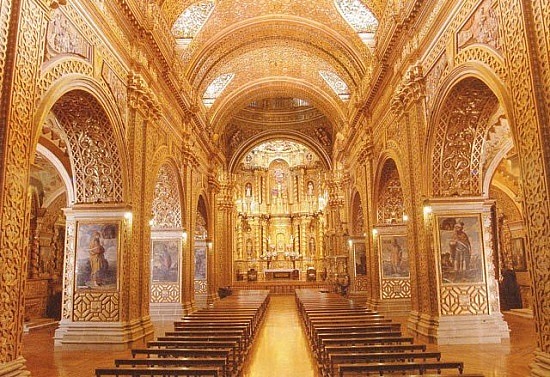
Also called the Church of the Society of Jesus, this Jesuit church just demands that the treasure hunter inside of you has to come and see this. It is known for it's spectacular interior design rather than it's outside architecture. Yeah, the design is great, but the jaw-dropping part here is that the nave inside is completely gilded in gold leaf, and is flat out, undeniable, heart thumping stunning. And it satisfies my need for history, having been built in the early 1600s.


Cathedral Nueva (Cuenca)
Known in English as the New Cathedral, this church is a more modern replacement for El Sagrario that I just mentioned. It has a different style than most, using red bricks instead of the massive stone work of other Ecuadorian churches. It has a much less ornate exterior. However the Cuenca downtown area is dominated by the brilliant blue domes. It sits near El Sagrario so it is a great and easy idea to check out both churches.


Church of San Francisco (Guayaquil)
This is a newer church in Guayaquil, by newer meaning it was built in the 1700s and 1800s. It's a pretty contemporary church compared to the rest of this list, but it's too lovely to pass by. My favorite part isn't so much the inside as the outside plaza. San Francisco is in the middle of the main business district of El Centro, not far from the US Consulate and a few blocks from the main Malecon 2000 touristy boardwalk. It is also surrounded by many markets of all shapes and sizes. A visit here can quickly turn into an all-day session.

Balbanera Church (Riobamba)
This is no where near the magnificence and iconic splendor of most of the other churches on my list, but if you are going through Riobamba this just tugs at the historian in me. I added this one because it has the notoriety of being the first Catholic church in all of Ecuador. I'll admit it's a very simple and understated building so don't expect a towering Gothic masterpiece. You go because you want to to see what most churches looked like in the 1500s and 1600s, not the masterpieces from the great cities. You go to Balbanera to commune with the ghosts of its nearly 500 year history.

Church of El Carmen of Asuncion (Cuenca)
This smooth stuccoed church has a much different look than the others, which is why I add it in as my final offering. This is more typical of a town church you would see outside of the great cities during the 1800s. Outside it is relatively plain, but inside it is an illogical puzzle of coves and nooks filled with statuary and sculpture. I love the clean lines and calm feeling of it. It is also conveniently in the old town area of Cuenca, a few blocks from La Catedral Nueva and is right on the edge of a large market.